

Our Advance Care Planning workshop
- End of life conversations are described as challenging and uncomfortable
- The discussions themselves can be emotionally complex for both patient and the clinician and the outcome of the discussion is difficult to predict.
(Lund, S, Richardson, A and May, C, 2015. Barriers to advance care planning at the end of life: an explanatory systematic review of implementation studies. PloS one, 10(2), p.e0116629)
About the workshop
This workshop is based on the SAGE & THYME conversational structure and was developed with the Lancashire and South Cumbria Cancer Services Network. The workshop focusses on the particularly challenging consultations that can introduce advance care planning (ACP) and end of life issues.
During the workshop, learners focus on effective communication skills that help open an advance care planning conversation. The structure provides a consultation guide as concerns and issues are disclosed.
The workshop is suitable for senior staff who would engage in advance care planning/end of life care discussions with patients and relatives in the course of their role (working at level 2 of the four level NICE communication model for psychological support).
The SAGE & THYME ACP workshop lasts for 3.5 hours, is run by 3 facilitators, and can be attended by up to 30 participants. It uses a combination of a lecture, small group work and interactive rehearsals of the conversation.
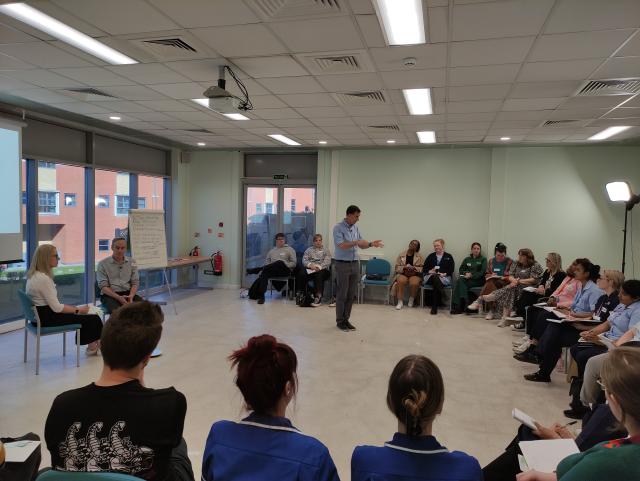
The SAGE & THYME ACP workshop has been delivered to a number of GPs, community nurses, acute and out-of-hours staff who are responsible for advance care planning.
The participants’ feedback has demonstrated that they have an increased confidence in starting an end of life care or advance care planning conversation, and in responding to a patient’s or relative’s concerns during the conversation.
They also rate their competence in conducting such a conversation more highly after the workshop.
Scroll down the page to see more information on this evidence.
Note that the workshop does NOT cover: breaking bad news; Mental Capacity Act; or specific advance care planning documents.
I was reasonably confident about communication in EoL [end of life] (perhaps cocky!), so when I attended the SAGE and THYME workshop last September I smugly thought I didn't have much to learn. I was wrong; it helped me greatly to structure conversations better. I used this structure for the Dying Matters DVD which was well received. The 30 GPs in Morecambe also gave very positive feedback.
Even if you feel experienced in ACP this course is absolutely invaluable. It certainly helped me to re think and improve personal practice and support others within our organisation. Thank you.
I was surprised that by letting the patient talk through things they seem more clear and definite of what they want/don’t want by the end of the conversation.
The course was professionally and effectively run by experienced facilitators. It was well pitched with a supportive style of facilitation. Practitioners report that the structure is really helpful for day-to-day practice with people approaching the end of their life.
I feel relieved that I now have more confidence to embark on end of life conversations.
You don’t always need to fix problems! Gathering, acknowledging concerns and allowing patients to discover a solution is the way to go.

An evaluation of the workshops with over 400 participants has been carried out:
- The workshop significantly increased from pre to post workshop: staff confidence in starting a conversation about advance care planning or end of life care and also in responding to concerns raised during such a conversation.
- Participants also showed a significant increase in perceived competence in conducting an advance care planning/end of life care conversation.
- 74% of participants said they would definitely change their practice as a result of the workshop.
- 88% of participants would definitely recommend the workshop to others.
Download the full report below.